Chapter 18- including a good map of Acts locations and Google map of current area
Chapter 18
Note 1: This Bible study is
being created specifically for a friend of mine. It is not meant as an
exhaustive study of the book of Acts. Please do your own research, using the
commentary links as a starting point, for a better understanding of the book of
Acts and other books of the Bible. Thank you for your dedication to studying
the word of God!
Note 2: All Bible verse
citations are from NKJV (New King James Version) unless otherwise stated.
Note 3: # This symbol will be
used for any information from Dr.
Nunnally’s “A Commentary on the Book of Acts” (Source info below). This
Bible study is heavily based on Dr. Nunnally’s work. I have not yet discovered
if he has published his book, but I will post a link for his work if I find out
that he has published it. Feel free to comment on this blog if you discover his
published book (if it’s published) before I do!
- All notes that have this or no symbol in front of them are my
interpretations of scripture.
*NIV Zondervan study Bible
+ other source (cited within
hyperlink or in “Sources” at bottom of page)
Verse 1: I
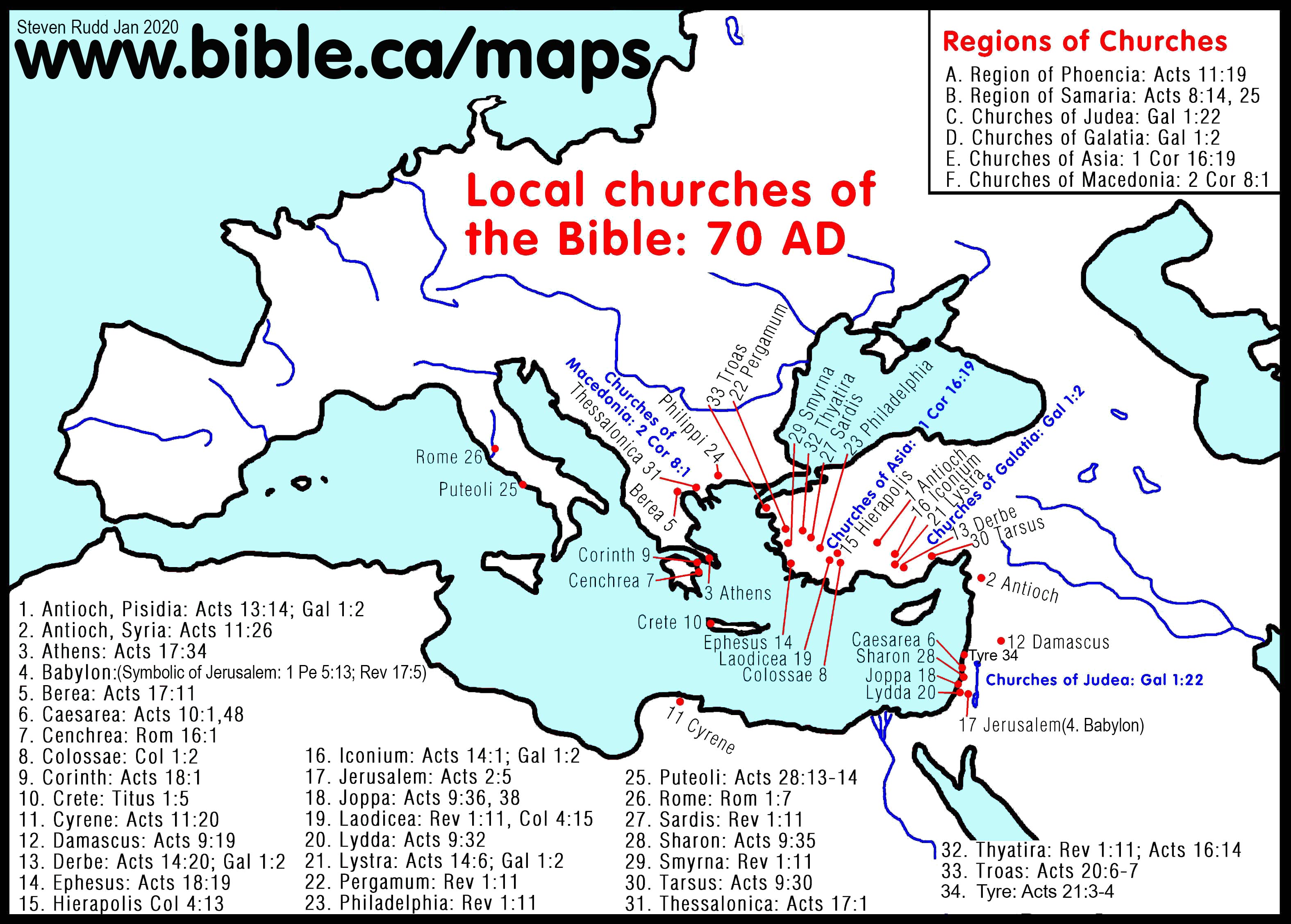
finally found an excellent map of the
ancient locations described in the book of Acts. I also pulled up a simple Google map
(thank you, Google!) that shows the same area with present day names and
country locations. Feel free to reference these maps throughout the course of
this study. Not every city mentioned
is on this map, but most of them are.
Verse 2: #1:
Claudius was the ruler of the area, and he had “expelled the Jews from Rome”
because of the riots that were happening between the Christians and the Jews.
When Claudius dies in AD 54, the rule is ignored and many Jews and Christians
return to the areas of Rome in which they had lived.
Verse 3: Most of
the time, Paul is supported by the donations of the churches which he has
helped start. However, this is one of the only examples in the Bible of a
“missionary” or “discliple/apostle” raising his/her own support through working
while ministering. Paul made and presumably sold tents in between his speaking
engagements in the synagogues and elsewhere. Many missionaries now call this
idea of working to raise one’s own support “tentmaking” as a result of this
example of Paul making tents in order to raise funds for his missionary
voyages.
Verse 5: Other
translations read, “Paul devoted himself exclusively to preaching,” (as opposed
to making the tents in between his speaking engagements). I think it is safe to
assume that Silas and Timothy also brought some donations with them, which
would help feed Paul and the others while they shared the message of Jesus in
Corinth.
- “compelled by the Spirit” means that Paul felt the Holy
Spirit was strongly directing him to do something (in this case, to preach).
Verse 6: “he
shook his garments” is basically the same gesture as “shaking the dust” off
one’s feet. These gestures are signs of extreme disgust and as a way of saying,
“Your blood/reputation be on your own head.” Jesus commanded his disciples to
shake the dust off of their feet in protest if people did not accept the
message they shared while they were traveling from city to city on his bidding
(Matthew
10:14).
Verse 12: #2: A
“proconsul” was a governor of a province, appointed by the Roman Senate. These
proconsul’s would be governor for a term of one year.
Verse 17: #3:
Even though the proconsul did not condemn Paul, the crowd decided to spitefully
attack Sosthenes instead. It may be that Sosthenes had allowed Paul to speak in
the synagogue, which would have been reason for the crowd to hate him as they
hated Paul. There is evidence that Sosthenes may have been a Christian or became
a Christian sometime after this event, assuming that he is the same Sosthenes
mentioned in 1
Corinthians 1:1.
Verse 18: #4: In
ancient times, it was not uncommon for a Jew to take the vow of the Nazarites,
which included several vows, one of which was not to cut your hair. In the Old
Testament, these vows were kept for a lifetime. By the time Paul took the vow
though, it had become acceptable to take the Nazarite vow for a period of time
as opposed to a lifetime, hence Paul getting his hair cut.
Sources
W.E. Nunnally. A Commentary on the Book of Acts, 2008, Evangel
University, 2008, Springfield, Missouri, 2017.
#1: pg. 405, 1st paragraph
#2: pg. 409, 1st paragraph
#3: pg. 410, last paragraph
#4: pg. 411, last paragraph
Comments
Post a Comment